
Best AEO Tools Ranked [Fall 2026 Edition]

By Bennett Cohen
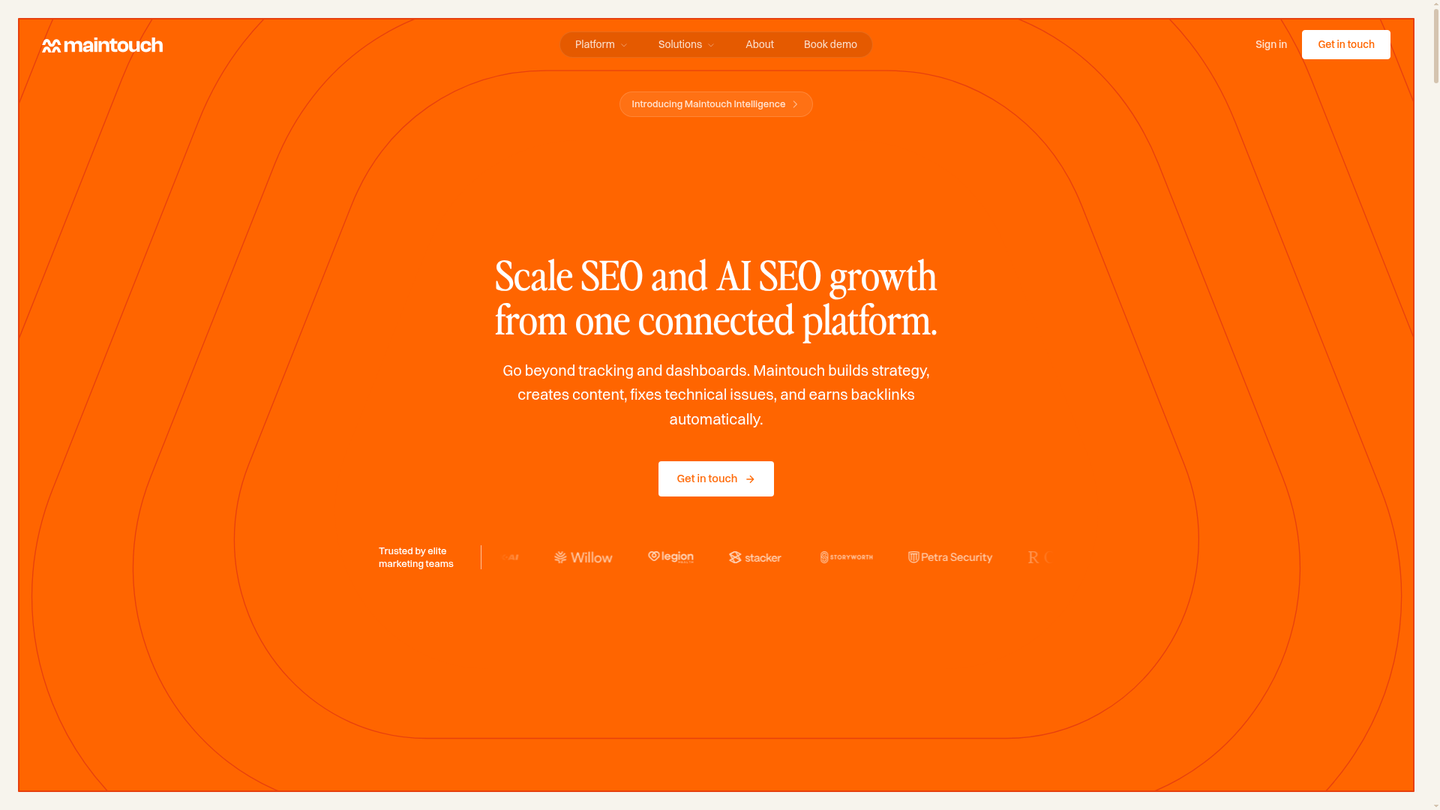
Get Maintouch
Turn search and AI visibility work into a repeatable growth system.
AI engines are answering questions your site used to rank for, and the traffic never hits your domain. You're getting cited or you're getting skipped. Google Analytics can't tell you which, and most AEO tools won't either past surfacing the gap.
That's the split that actually matters in this category: tools that watch, and tools that fix. The best ones track brand mentions across ChatGPT, Perplexity, Google AI Overviews, Gemini, and Claude. The honest ones admit a dashboard showing your share of voice is dropping is worthless if it can't tell you which passage to rewrite or which schema to add. I spent 2025 testing every major option against that single question — does it execute, or does it just report?
TLDR:
- 59.7% of Google searches now end without a click, so AI citation tracking across ChatGPT, Perplexity, Google AI Overviews, Gemini, and Claude is the new scoreboard
- Maintouch is the only tool here that runs the full SEO and AEO program end to end — agents build strategy, write content, fix technical issues, acquire backlinks, and track citations across all five engines
- Every other tool on this list stops at monitoring: you pay $200 a month for a dashboard, then hire writers, editors, and link builders to act on it
- Execution carries the ranking. A tool that closes a citation gap scores far above one that just points at it
What Are AEO Tools?
Start with the acronym. AEO stands for answer engine optimization. These tools track, measure, and improve how your brand shows up inside AI-generated answers across ChatGPT, Perplexity, Google AI Overviews, Gemini, and Claude.
They exist because the old scoreboard stopped telling the full story. For years, visibility meant rankings and clicks. Someone typed a query, you ranked, they clicked, GA4 logged the visit. Clean line, easy math.
That line is breaking. Similarweb's 2024 zero-click study found 59.7% of Google searches now end without anyone visiting a website. The answer arrives on the results page itself, served through an AI overview or a featured snippet. Pew Research saw the same pattern: users who got an AI summary were far less likely to click any link on the page. The searcher never lands on your site. The visit doesn't happen. The influence does.
AEO tools sit upstream of that broken click. They watch the moment an AI engine decides which sources to pull into its answer, because by the time a user reads the response, the decision is already made. The mention is the visibility now.
What a good AEO tool actually measures:
- Citation frequency: how often a given AI engine references your brand when answering a relevant prompt
- Share of voice: how your citation count stacks up against competitors for the same set of questions
- Sentiment: whether the AI describes your brand accurately and favorably when it does mention you
- Coverage across engines: tracking all five major systems separately, because being cited heavily in Perplexity tells you nothing about whether ChatGPT skips you entirely
Why these need their own category comes down to mechanics. An AI engine breaks a question into sub-queries, runs them in parallel, and stitches an answer together from the passages that resolve each piece cleanly. Whether your overall page ranks matters less than whether a specific chunk of your content nails a specific sub-question. Traditional rank trackers can't see any of that; they report position on a results page the user might never reach.
An AEO tool is the instrument layer for a channel where the click is no longer the unit of value. The mention is.
How We Ranked the Best AEO Tools
Before I rank anything, you should know where I'm judging from. I've been doing SEO for over a decade. Maintouch now serves hundreds of marketers running this exact playbook. I grew up around the agency side of the business, watching which tools actually moved a number and which ones produced nice charts and nothing else. I graded every option here on what it does, not how it markets itself.
Six factors decided the ranking:
- AI engine coverage: how many of the five major systems a tool tracks. Covering ChatGPT but skipping Claude leaves a real hole in your data, and plenty of tools quietly do exactly that.
- Citation tracking: whether it monitors brand mentions and the source URLs feeding them, so you know which of your pages an engine pulled from versus which competitor page won the spot.
- Content optimization: whether the tool hands you actionable recommendations or stops at a dashboard. A chart showing you're losing share of voice is useless if it can't tell you which passage to rewrite.
- Workflow integration: how tightly visibility data connects to the work that fixes it. Most tools dead-end here. You see the problem in one window and go fix it in five others.
- Pricing transparency: whether the cost is published or buried behind a sales call. Hidden enterprise pricing usually means the number is high enough to scare you off the page.
- Monitoring versus execution: this is the big one. A tool that only watches is a different product from one that improves and ships changes.
That last distinction matters more than the rest combined, so I'll be blunt about it. Monitoring tells you a competitor is getting cited and you aren't. Worth knowing. But knowing is the cheap part. The expensive part is the rewrite, the schema, the backlinks that get your page into the retrieval set in the first place, and a monitoring-only tool leaves every bit of that on your desk.
From auditing AI-cited pages across the companies we work with, that's exactly where most budgets quietly bleed. You pay $200 a month for a clean chart, then pay a writer, an editor, and a link builder to act on it. So I weighted execution heavily. A tool that closes a citation gap scores far above one that just points at it.
Best Overall AEO Tool: Maintouch
Most of this list is point tools. Maintouch is the exception.
I built it to replace the SEO and AEO agency outright, not to add one more dashboard to a stack you're already drowning in. One system handles strategy, content, technical SEO, backlinks, and citation tracking across all five major engines. Agents do the work. A dedicated strategist runs a 15-20 minute standing meeting each week to align priorities, and the software executes from there.
The whole thing runs on four data inputs so content stays grounded in your actual context instead of generic filler:
- Knowledge: API docs, Notion, Confluence, brand guidelines, and custom context you upload
- Customer signals: HubSpot, Salesforce, Attio, and sales call recording tools like Read.ai, Grain, Circleback, Gong, and Granola
- Competitor signals: Reddit, G2, Capterra, Meta, and LinkedIn
- Data: Google, ChatGPT, Claude, Semrush, Ahrefs, PostHog, GA4, and Google Ads
What Maintouch offers
The context engine pulls from those inputs to build strategy off your real customer language, not keyword guesses. From there, everything runs as one coordinated system.
- Content agents: write and optimize pieces with internal linking pulled from Google Search Console primary-keyword data, external source citations, and FAQ schema built for AI extraction
- Technical agents: scan your site for metadata gaps, JSON-LD issues, robots.txt and canonical problems, client-side rendering issues, page size, and page speed, then push the fixes through your CMS instead of leaving them in a report
- Backlink agents: flag pages ranking in positions 5 through 20, the striking-distance range where a few links actually move the needle, acquire them through integrated marketplaces at zero-markup pass-through pricing, and monitor to keep them live
- Citation tracking: watches your brand across ChatGPT, Claude, Gemini, Perplexity, and Google AI Overviews in one view, with citation rate as the metric that matters
Good for
B2B SaaS and venture-backed brands that want to replace an agency retainer, typically $3,000 to $10,000 a month, with an agency replacement system that executes instead of advises. Agents handle roughly 95% of the work an agency would do. Your dedicated strategist guides the remaining 5%, the strategic calls that need human judgment. Pricing is built to replace agency spend, with tiers that scale to the account.
Bottom line
Maintouch is the only option here that runs the full SEO and AEO program end to end. Every other tool on this list hands you insights and leaves the execution on your desk: the rewrite, the schema, the links, the publish. Agents build the strategy, write the content, fix the technical issues, acquire the backlinks, and track the citations. You're replacing the agency stack, not bolting another point tool onto a workflow that's already fragmented.
Search Atlas
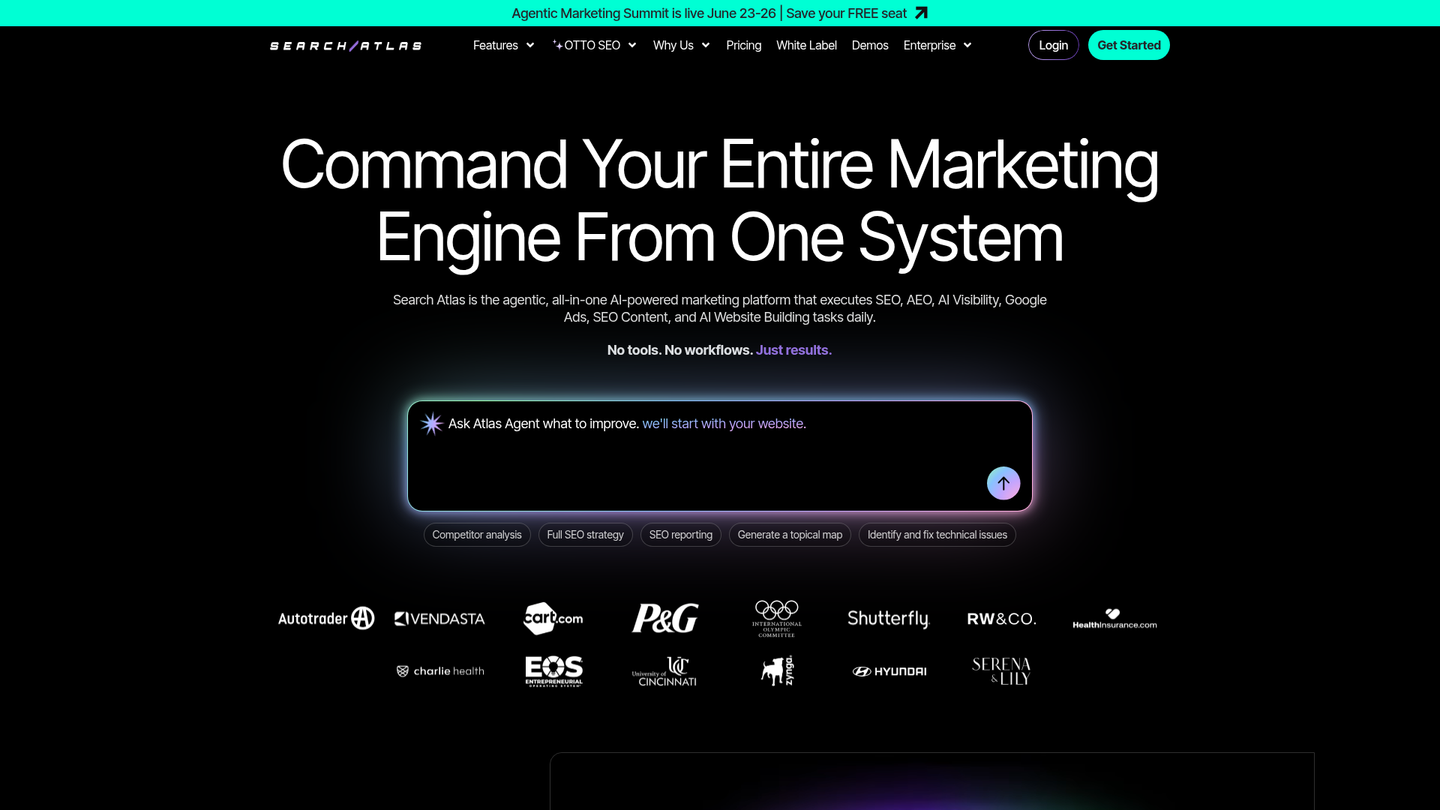
Search Atlas is an AI-driven SEO suite that bundles keyword research, content optimization, and technical auditing, then layers AI visibility tracking on top through a tool called QUEST. What sets it apart from pure research suites is OTTO, an AI agent that pushes technical fixes through a JavaScript pixel instead of just flagging them. Add Content Genius for AI-assisted writing, and you get a suite that does more than report.
What they offer
- OTTO SEO automation handles technical fixes (meta tags, schema markup, canonical URLs) by installing a pixel on your site and applying changes without direct CMS access
- Content Genius Agent generates content with semantic optimization and topical authority mapping
- QUEST monitors visibility across ChatGPT, Perplexity, and AI Overviews as part of its generative engine optimization push
- GBP Galactic covers local SEO through Google Business Profile automation and review management
Good for
Agencies and SMBs that want to collapse a stack of subscriptions into one bill. If you're paying for Semrush on research, Surfer on content, and BrightLocal on local, Search Atlas folds all of that into a single suite with 60+ integrated tools, plus OTTO doing implementation instead of leaving fixes in a report.
Limitation
The AI visibility piece is the catch. QUEST is gated to Growth-tier plans and above, so the LLM tracking you came for isn't available on Starter.
The OTTO pixel is clever, but applying changes through injected JavaScript runs into trouble with strict Content Security Policies or heavy front-end frameworks. You end up making manual configuration tweaks that chip away at the whole point of automation. Content Genius optimizes a page at a time. It doesn't run the full content program, which means strategy, writing, internal linking, schema, and publishing still live across separate workflows you have to coordinate yourself.
Bottom line
Search Atlas fits agencies juggling multiple client sites that want consolidated tooling with some AI visibility bolted on. The wall is depth of execution. OTTO handles a slice of technical fixes; the rest — strategy, writing, internal linking, schema, backlink procurement — still lives across separate workflows you coordinate yourself. Maintouch runs all of that as one connected system, with agents writing and shipping the content, pushing technical fixes through CMS integrations, and procuring backlinks for striking-distance pages instead of leaving any of it on your desk.
Clearscope
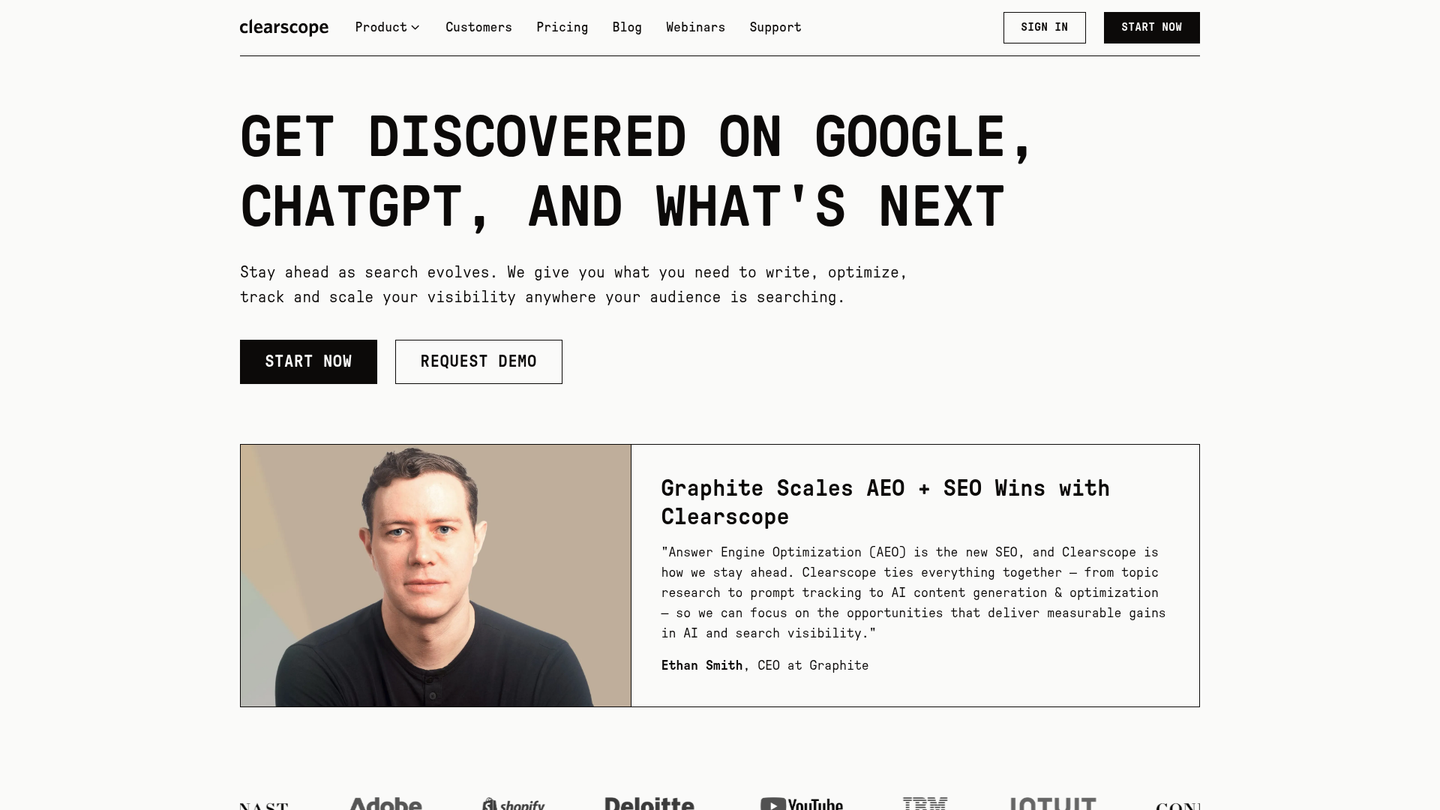
Clearscope built its reputation on content grading. Feed it a target keyword, and it analyzes the top 30 ranking results to hand you a term list and a real-time score that climbs from F to A+ as you write. As of 2025 it includes LLM visibility tracking and AI drafting on top of that core. The tool that used to grade your SEO content now watches AI engines too.
What they offer
- Content optimization reports that analyze the top 30 search results and return term-frequency recommendations with live grading as you write
- Content Inventory that connects to Google Search Console to track performance, flag decaying pages, surface striking-distance queries, and log algorithm updates
- AI drafting that generates text-only drafts off a selected search intent, with human editing and fact-checking required before anything goes live
- Integrations into Google Docs, WordPress, and Microsoft Word so the grading happens inside the editor you already use
Good for
Experienced content teams and SEO agencies producing in-depth content for competitive keywords. If you have writers who already know the craft and just need a consistent optimization standard to grade against, Clearscope fits, assuming you have room in the budget for a premium seat ($170 to $500 a month depending on tier).
Limitation
Clearscope doesn't learn from your edits. Every piece runs through the same manual optimization loop. The tool never picks up your brand voice, your style preferences, or the corrections you make on every draft. The work scales linearly with volume. Write twice as much, do twice the manual refinement.
That's the opposite of how the self-learning engine behaves, where each human edit feeds back into the knowledge base, blog rules, and brand voice so the next draft starts closer to finished.
The AI drafting has the same ceiling. It produces a text-only starting point, so formatting, fact-checking, image creation, and schema implementation all stay on your plate. You get words, not a publishable asset.
Bottom line
Clearscope works if you have writers on staff and time to hand-tune each piece against a grader. Scale is the ceiling — and the per-seat price is the floor. Maintouch agents write the draft, format it, add FAQ schema, pull internal links from Search Console data, and publish through your CMS, and the self-learning engine sharpens with every edit you make. You're not paying $170 a seat for a grading tool; you're replacing the writers and editors entirely.
Semrush
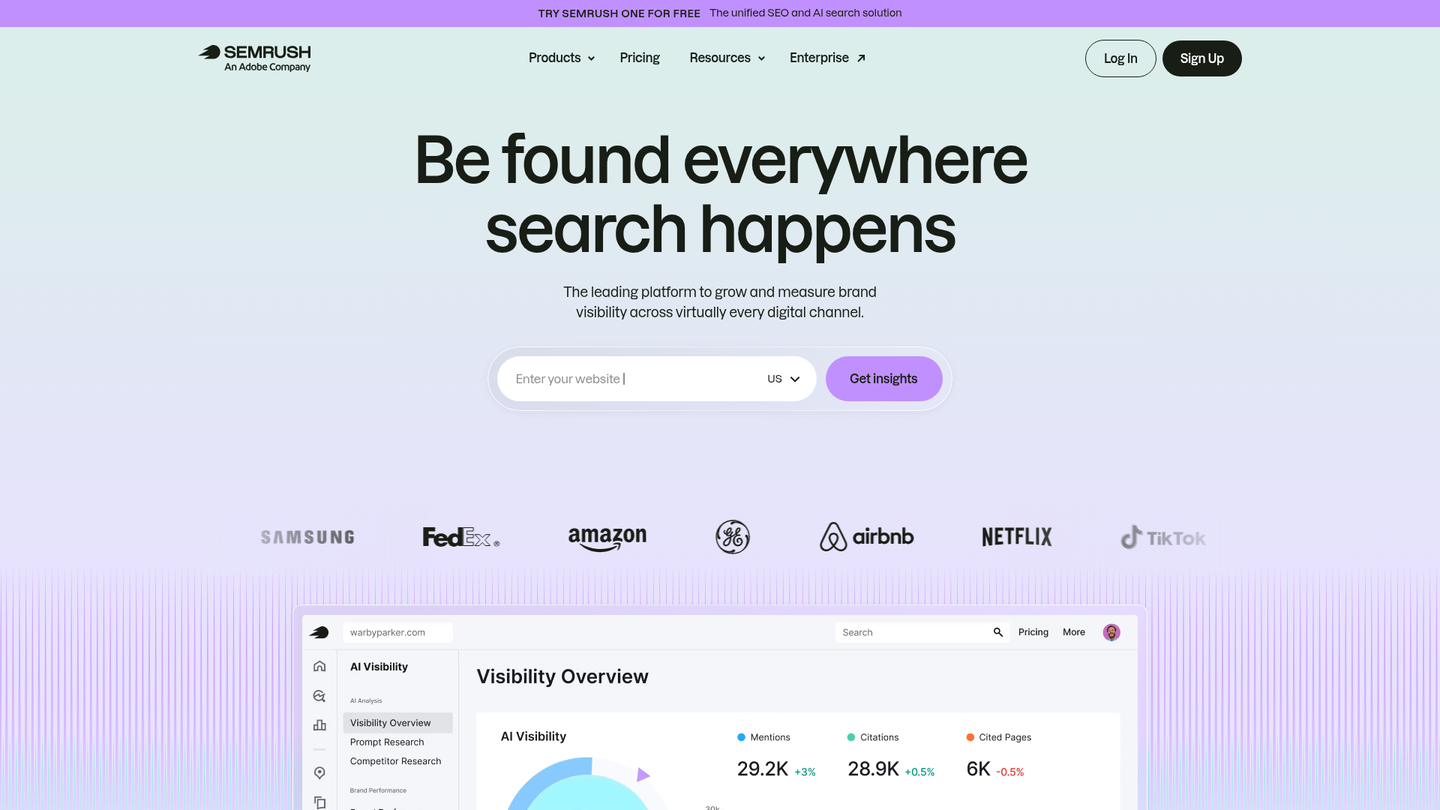
Semrush has been around long enough to be the default answer when someone asks which SEO tool to buy. The data set is the reason. It covers 26+ billion keywords across 142 databases plus one of the largest backlink indexes on the market, according to its own reporting.
If raw data and reporting are all you want, Semrush is hard to beat. In 2025 it bolted on AI search tracking through its AI Toolkit, so keyword research, site auditing, backlink analysis, and rank tracking now sit next to brand-mention monitoring across ChatGPT, Perplexity, Google AI Overviews, Gemini, and Claude.
What they offer
- AI Toolkit tracks brand visibility and sentiment across major AI engines, showing which prompts trigger your brand and how you stack up against competitors inside AI answers
- Keyword Magic Tool runs keyword research against 26+ billion keywords across 142 databases for traditional SEO planning
- Site Audit crawls technical issues across 140+ checks, covering schema, internal linking, and Core Web Vitals
- Backlink Analytics taps one of the largest link databases for competitor link analysis and outreach prospecting
Good for
In-house marketing teams and agencies that want one tool spanning keyword research, technical audits, backlinks, and AI visibility monitoring, with the budget for the Business tier ($499 a month) where the AI Toolkit features unlock.
Limitation
Semrush reports across 50+ tools and stops there. The work stays on you. Technical audit issues need manual fixes through your CMS or dev team. Content recommendations need a writer to implement them. Backlink prospects need a manual outreach campaign before a single link goes live.
The AI Toolkit shows where you appear in AI answers, but it offers no path to improve those citations beyond surfacing the data. You see the gap. Closing it is a separate job across separate workstreams.
Bottom line
Semrush fits teams that already have the SEO specialist, the content writer, and the outreach coordinator on payroll and need 50+ dashboards to feed them. The data depth is real. The handoff is the cost — every insight is a ticket someone has to close. Maintouch takes the same coverage and runs it as one program: agents track citations, write the optimized content, push technical fixes through your CMS, and procure backlinks for striking-distance pages, so the work that Semrush points at is the work Maintouch ships.
Ahrefs
Ahrefs is one of the oldest incumbents in the industry. Its backlink index and keyword data set are what years of competitors have tried to catch. If pure data is what you're after, Ahrefs does that job about as well as anyone.
AI search visibility arrived through Brand Radar, available as of 2024, which tracks how often your brand turns up in AI Overviews and ChatGPT, sitting alongside the rankings, backlinks, and site-health data the tool has always been known for.
What they offer
- Brand Radar monitors brand mentions in AI Overviews and ChatGPT responses, showing which queries trigger your brand and what sources AI engines cite when discussing your category
- Site Explorer runs detailed backlink analysis off a deep live link index, with referring domains, anchor text breakdowns, and lost-link alerts
- Keywords Explorer handles keyword research with traffic estimates, parent topic clustering, and SERP feature data
- Site Audit crawls for 170+ technical SEO issues, ranked by traffic impact
Good for
SEO teams and link-building specialists that care most about backlink data quality and need detailed competitor link analysis, with the budget for the Standard plan ($249 a month) or higher to unlock full Brand Radar and Site Explorer features.
Limitation
Ahrefs delivers some of the best data in the business and stops at reporting. Backlink prospects surfaced through Site Explorer still need a manual outreach campaign. Technical issues flagged by Site Audit turn into developer tickets. Brand Radar shows you where AI engines skip your brand without handing you a way to fix it.
The insight is sharp. Acting on it is your problem. Agents take that same category of insight and run with it, acquiring backlinks through integrated marketplaces, pushing technical fixes through CMS integrations, and writing optimized content built to earn citations across all five major engines.
Bottom line
Ahrefs is a strong fit for SEO specialists with the time and outreach muscle to turn deep backlink data into shipped links. The data quality earns its reputation. Maintouch fits B2B SaaS teams that don't want to run outreach campaigns at all — agents flag striking-distance pages, procure the backlinks through integrated marketplaces at zero-markup pass-through pricing, write the content that earns citations, and track the results across all five major AI engines as one system.
Surfer SEO
Surfer SEO grades content against the SERP. Feed it a keyword, and it pulls the top 20 ranking results to build a target score, a term list, and structural recommendations you work against in real time while you write. It does that on-page optimization loop well.
What they offer
- Content Editor scores your draft in real time off the top 20 search results, with keyword density and semantic relevance guidance as you write
- SERP Analyzer breaks down competitor pages to surface common themes and content gaps you're missing
- AI content generation produces draft outlines and full articles at $19 per piece on the base tier
- Google Docs integration brings the scoring into the editor you already write in
Good for
Individual content marketers and small teams shipping 10 to 30 articles a month who want SERP-based guidance and have the time to optimize each piece by hand inside the editor.
Limitation
Surfer doesn't read your edits. Every article runs the same manual loop. The tool never absorbs your brand voice, your style calls, or the corrections you make on every draft. Do twice the volume, do twice the hand-tuning. The work never gets lighter.
The bigger ceiling is architecture. Surfer is built for individual pages and small batches, not programmatic runs. If you're generating hundreds or thousands of location pages or template-driven entries, you're forced into a page-by-page workflow that was never designed for that scale. And when those pages need backlinks, automated backlink procurement platforms become the only way to scale link acquisition without manual outreach campaigns eating your entire quarter.
The pricing makes it worse. Surfer runs $89 a month base plus $19 per AI article, capped at 30 articles on the basic plan. A 100-page programmatic campaign would cost north of $1,900 in article fees alone before you've optimized anything.
For true programmatic SEO, the per-article model gets expensive fast.
Bottom line
Surfer fits a solo marketer shipping a handful of articles a month who wants SERP-based guidance while they write. Past that, the per-page model breaks: a 100-page programmatic run costs $1,900 in article fees before optimization. Maintouch agents run the whole workflow from strategy through publish, support programmatic SEO across hundreds or thousands of pages without per-article fees, and get sharper over time as the self-learning engine updates the knowledge base, blog rules, and brand voice from your editing patterns.
Feature Comparison Table of Best AEO Tools
Before the table, the pattern in plain English. Every tool here stops at a different point in the same workflow:
- Search Atlas ships some technical fixes through a JavaScript pixel, then hands content, strategy, and links back to you
- Clearscope grades your draft and stops at the editor — every other step is yours
- Semrush reports across 50+ dashboards and assumes you have the team to act on each one
- Ahrefs surfaces backlink prospects and leaves outreach, content, and technical fixes on your plate
- Surfer scores pages one at a time at $19 per AI article on top of the base subscription
- Maintouch runs the entire program — strategy, content, technical fixes, backlink procurement, and citation tracking — as one connected system
Here's how that lands in a table. The execution columns (technical fixes, backlinks, publishing, programmatic support) stay empty for everyone but Maintouch.
| Feature | Maintouch | Search Atlas | Clearscope | Semrush | Ahrefs | Surfer SEO |
|---|---|---|---|---|---|---|
| AI citation tracking | Yes | Yes | Yes | Yes | Yes | No |
| Automated content creation | Yes | Yes | Yes | No | No | Yes |
| Technical SEO automation | Yes | Yes | No | No | No | No |
| Backlink procurement | Yes | No | No | No | No | No |
| Self-learning content engine | Yes | No | No | No | No | No |
| CMS publishing integration | Yes | Yes | No | No | No | No |
| Dedicated strategist | Yes | No | No | No | No | No |
| Programmatic SEO support | Yes | No | No | No | No | No |
| Pricing (starting) | Tiered, priced to replace agency spend | $99/mo | $170/mo | $139/mo | $129/mo | $89/mo |
The columns matter more than the rows here. Citation tracking is table stakes now. Five of six check that box. The difference shows up in what happens after the dashboard flags a gap. Backlink procurement, the self-learning loop, and a dedicated strategist run down a single column. The work of closing a citation gap lives in exactly those features the other tools leave blank.
Why Maintouch Is the Best AEO Tool
Every other tool on this list stops at the same place: it tells you something, then hands the work back. Maintouch doesn't hand it back. Agents run the whole program from strategy to publish, and the gap between knowing and doing closes inside one system.
The mechanics, concretely:
- A four-input context engine pulls from your knowledge (API docs, Notion, Confluence, brand guidelines), customer signals (HubSpot, Salesforce, Attio, plus call recording tools like Read.ai, Grain, Circleback, Gong, and Granola), competitor signals (Reddit, G2, Capterra, Meta, LinkedIn), and data (Google, ChatGPT, Claude, Semrush, Ahrefs, PostHog, GA4, Google Ads)
- Content agents draft, optimize, add FAQ schema built for AI extraction, and insert internal links pulled from Google Search Console primary-keyword data, then publish through your CMS
- Technical agents scan for metadata gaps, JSON-LD issues, robots.txt and canonical problems, client-side rendering, page size, and page speed, then push the fixes through CMS integrations instead of leaving them in a report
- Backlink agents flag striking-distance pages (positions 5-20), acquire links through integrated marketplaces at zero-markup pass-through pricing, and monitor to keep them live
- Citation tracking watches your brand across ChatGPT, Claude, Gemini, Perplexity, and Google AI Overviews in one view, with citation rate as the metric that matters
The self-learning engine sharpens with every edit you make, so the next draft starts closer to done instead of repeating the same corrections forever.
That last part is what separates a system from a subscription. A monitoring tool gives you the same blank dashboard month after month. Maintouch gets better the longer you run it.
For B2B SaaS and venture-backed brands, the math is simple. You're replacing a $3,000 to $10,000 a month agency retainer with an agency replacement system priced to do exactly that. Agents handle roughly 95% of the work. Your dedicated strategist guides the remaining 5% in a 15-20 minute standing meeting each week.
You get agency-level execution without the agency timeline, the coordination cycles, or the people management.
If you're picking an AEO tool, the real question is whether you want one more dashboard or the thing that does the work. Maintouch does the work.
I've been doing SEO for over a decade, and Maintouch serves hundreds of marketers running into this same wall. If you want to talk through what replacing your agency stack would look like on your site, shoot me a message. I'll walk you through it.
What to do next
If you want to see the system in action against your own site, book a demo and we'll show you the citation gaps your competitors are winning, the striking-distance pages worth attacking first, and what an agent-run program looks like end to end. If you'd rather start by watching, the free tier at maintouch.com/free tracks 50 prompts across all five engines for a year, no credit card.
Final Thoughts on Selecting AEO Tools for Your Stack
Pick a dashboard if you want to know where you're losing citation share. Pick a system if you want to close the gap. Most of this list is the first kind. Maintouch is the only one built end to end for the second.
A decade of watching companies drown in reporting tools taught me one thing: the work of rewriting content, adding schema, and acquiring backlinks never gets lighter when you add another subscription on top. It only gets lighter when something else does the work.
FAQ
How do I choose the right AEO tool for my needs?
Start with coverage and execution depth. If you need citation tracking across all five major AI engines (ChatGPT, Claude, Gemini, Perplexity, and Google AI Overviews) plus automated content creation, technical fixes, and backlink procurement in one system, Maintouch replaces the entire agency stack. If you just want monitoring dashboards and can handle execution yourself across separate tools, point solutions like Semrush or Ahrefs work fine.
Which AEO tool is better for small teams versus agencies?
Small teams with limited budgets typically benefit more from all-in-one systems like Maintouch or Search Atlas that collapse multiple subscriptions and automate execution, since you're replacing a full agency retainer with one system. Agencies managing multiple client sites often prefer research-heavy suites like Semrush or Ahrefs where they already have specialists to execute on the insights and need deep data across many accounts.
Can I track AI citations without paying for enterprise pricing?
Yes. Maintouch offers free AI visibility tracking for one full year at maintouch.com/free with 50 prompts tracked across all five major engines and no credit card required. Most competitors gate AI citation tracking behind Growth or Business tiers ($200+ per month), making the free tier a solid entry point if you want to test AEO monitoring before committing to paid execution features.
What's the main difference between monitoring tools and execution platforms?
Monitoring tools like Semrush, Ahrefs, and Clearscope surface insights and stop there - you see the citation gap, then manually write content, fix technical issues, and build links across separate workflows. Execution platforms like Maintouch and Search Atlas automate the work itself, with agents writing optimized content, pushing technical fixes through CMS integrations, and acquiring backlinks instead of just flagging opportunities in a dashboard.
How long does it take to see results from AEO optimization?
In my experience working with hundreds of companies, most sites see initial AI citations within 2-3 months after implementing structured FAQ schema and passage-level content optimization. Traditional SEO rankings typically take 6-7 months to move meaningfully, but AI citation wins can happen faster because engines favor recently updated content with clean markup - pages refreshed in the last 90 days get cited far more often than stale content, even when the stale page ranks higher organically.
Do I need separate tools for SEO and AEO, or can one tool handle both?
Most tools on this list handle one or the other, which means you're paying for two subscriptions and coordinating work across separate dashboards. Maintouch runs the full SEO and AEO program as one connected system - agents optimize content for traditional search rankings while simultaneously structuring it for AI citation across ChatGPT, Perplexity, Claude, Gemini, and Google AI Overviews. The work feeds from the same content engine, technical audit layer, and backlink procurement system instead of splitting into separate workflows.
What's the difference between monitoring my brand in AI responses and actually improving those citations?
Monitoring shows you where you appear and where competitors beat you - that's what most AEO tools deliver. Improving citations means rewriting content to answer questions directly in the first sentence under each heading, adding FAQ schema that engines can extract, and acquiring backlinks to pages that already rank in striking distance so they break into the retrieval set. That execution work is what separates a dashboard from a system that actually moves your citation rate.
How much does it cost to run a full AEO program in-house versus using an automated tool?
Running it in-house typically means a content writer at $4,000-6,000 per month, an SEO strategist at $6,000-8,000, tool subscriptions for citation tracking and keyword research at $300-500, plus technical resources for schema implementation and CMS fixes. That stack runs $10,000-15,000 monthly before you've published anything. Maintouch pricing is built to replace that entire agency spend with tiered plans that scale to your account, with agents handling 95% of the execution work.
Can I track citations in ChatGPT without paying for an enterprise AEO tool?
Most tools gate AI visibility tracking behind Growth or Business tiers at $200+ per month. Maintouch offers free citation tracking for one full year at maintouch.com/free with 50 prompts monitored across all five major engines and no credit card required. That's enough to see where you stand before committing budget to the full execution platform.
Which AI engine should I prioritize if I can only focus on one?
Start with the engine your target audience actually uses. B2B SaaS buyers skew heavily toward ChatGPT and Perplexity for research queries, while consumer search still runs through Google AI Overviews at higher volume. Check your GA4 referral report to see which engines already send traffic, then optimize for those first. That said, the citation work - structured content, FAQ schema, direct answers under headings - improves visibility across all five engines simultaneously, so you're not really picking one in practice.
What's the fastest way to start getting cited in AI answers if I'm starting from zero?
Pull your Google Search Console data and filter for queries where you rank positions 11-20. Those are striking-distance pages that already have some authority but need tighter content structure. Rewrite the intro to answer the primary query in the first sentence, add an FAQ section with natural follow-up questions, and implement FAQ schema markup. Those three moves typically surface citation wins within 6-8 weeks because you're optimizing pages that engines already see as relevant - you're just making them easier to extract and cite.
Do backlinks still matter for AI citations, or is it all about content structure now?
Both matter, but they do different jobs. Backlinks get your page into the retrieval set - the pool of candidates an AI engine considers when answering a query. Structured data and clean schema determine whether your page gets cited once it's in that pool. A page with clean FAQ schema and no backlinks won't get retrieved. A page with strong backlinks but buried answers won't get cited. You need domain authority to get in the room and passage-level optimization to win the mention.
Turn search into your best growth channel.
Maintouch tracks your visibility across AI and Google, creates and refreshes content, and gets your brand mentioned on the sites that shape discovery.
Book a demoRelated reading
All posts