
Peec AI vs Profound: Best Pick in September 2026

By Bennett Cohen
Get Maintouch
Turn search and AI visibility work into a repeatable growth system.
If what you need is execution, picking between Peec AI and Profound is the wrong question. Both tools watch how often your brand shows up when answer engines respond to buyer prompts, and both stop at the report. Peec hands you a clean citation frequency feed across the major AI surfaces. Profound layers in crawler analytics, sentiment tracking, and a content assistant wired to your CMS. The scoreboard tells you a competitor is cited twice as often as you are. What it doesn't do is write the content, earn the links, fix the technical issues, or coordinate the cycle that turns visibility data into actual mentions. That work still lives on your team.
TLDR:
- Peec starts at $95/month for three engines; Profound has moved to enterprise-only with customer-reported quotes of $50,000+ per year
- Both tools report where you stand in AI citations, then leave content, links, and fixes on your desk
- Add-on costs scale with tier: Peec charges $35-$165/month per extra engine depending on plan level
- Peec is a clean monitoring feed; Profound layers in crawler analytics, sentiment tracking, and a content assistant that publishes to WordPress, Sanity, and Contentful
- Claude tracking sits on Profound's Enterprise tier and runs through the API instead of the user interface, so reported citations can drift from what buyers actually read on screen
- Maintouch tracks five engines (ChatGPT, Claude, Gemini, Perplexity, Google AI Overviews) with plans starting at $149/month and a 5-day free trial at maintouch.com; Claude tracking starts at the Hypergrowth tier ($799/month), and the system runs the content, technical, and backlink work both tools leave on your team
What is Peec?
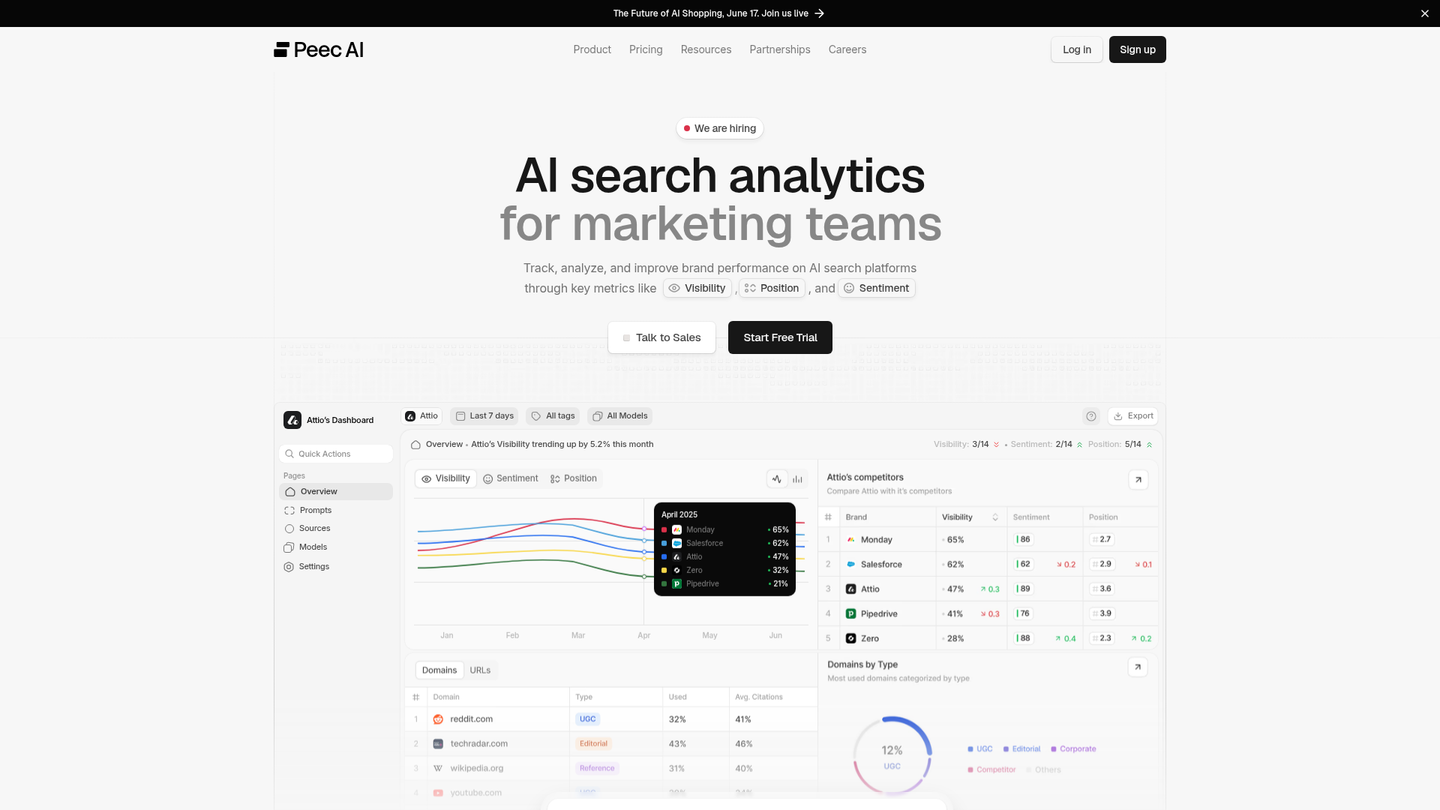
Peec AI is a monitoring tool. It tracks how often your brand surfaces when answer engines respond to buyer prompts, then reports that frequency back across the major AI surfaces. Note that Claude is absent from Peec's seven-engine menu entirely.
Pricing is the easy part. Plans start at $95 a month with clean tiers, which makes Peec one of the simpler tools to budget for if monitoring is all you want.
Coverage spans seven engines: ChatGPT, Perplexity, Gemini, Microsoft Copilot, AI Mode, AI Overviews, and Grok. The catch is the three-model cap on every tier below Enterprise. You pick three, then climb the pricing ladder for the rest.
Diagnosis is where Peec earns its keep. It tells you a competitor shows up more often than you do, tracks the gap over time, and gives you a clean read on each engine you're watching.
Treatment is where it stops. The tool flags that you're losing citation share, but it won't tell you why, and it won't do anything about it. No content layer, no technical fixes, no link building. You get the scoreboard and you're on your own for the plays. That diagnosis-without-action gap is the recurring complaint from teams who adopt Peec expecting more.
A team with writers, strategists, and engineers already on staff can absorb that. A lean team gets stuck holding the hard part.
What Profound Does and Its Approach
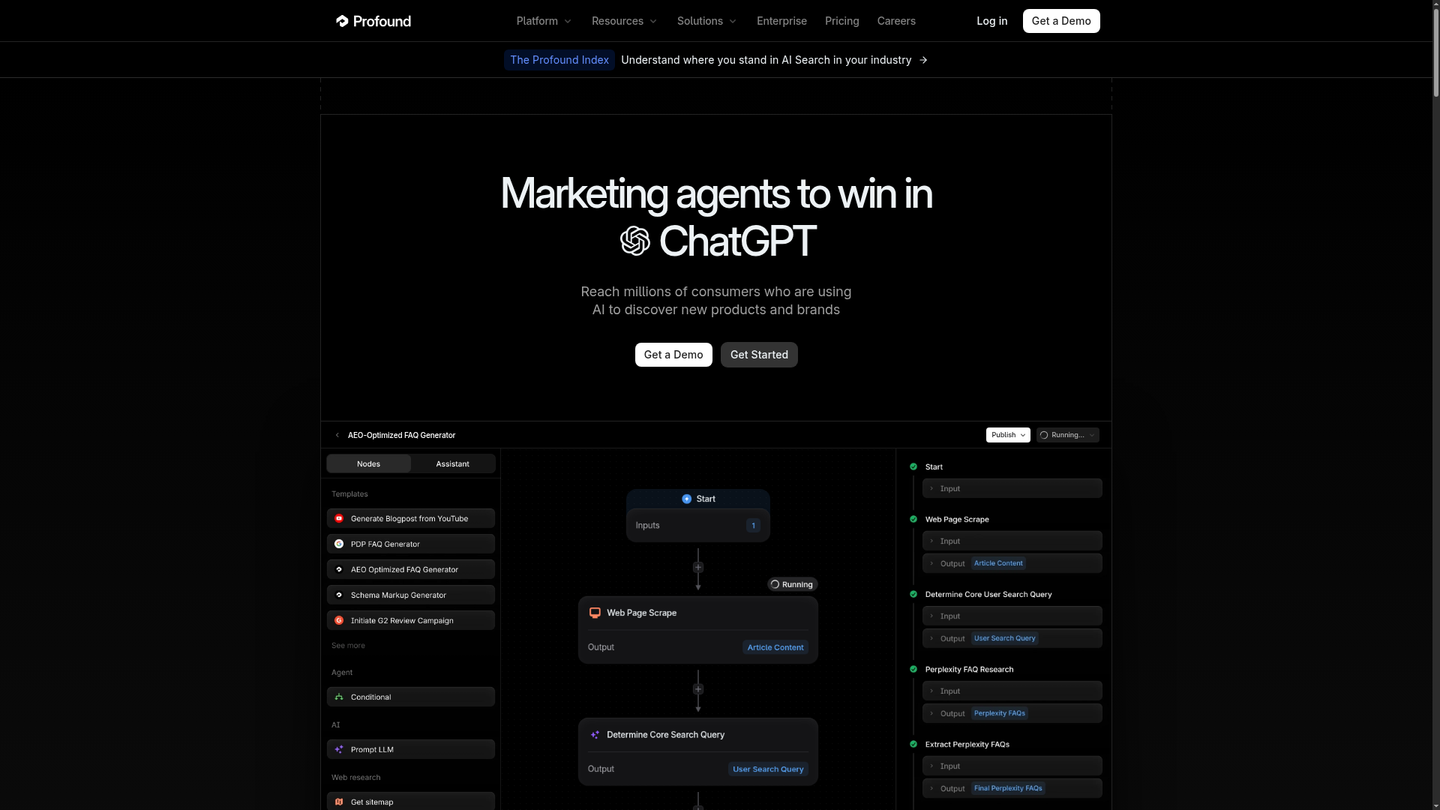
Profound plays in a higher weight class. It's an enterprise AI visibility tool tracking your brand across ChatGPT, Perplexity, Google AI Overviews, and the rest, backed by a Series B from Sequoia (August 2025). As of 2025, Profound has moved to enterprise-only sales with no ongoing self-serve tier.
Two products carry the load. Answer Engine Insights watches how AI surfaces represent your brand across ChatGPT, Perplexity, Claude, and AI Overviews, then layers in real-time search volume, sentiment, and traffic attribution from AI-driven search. Agent Analytics goes a layer deeper, reading how AI crawlers actually behave on your site.
That crawler intelligence is the piece Peec doesn't touch. Want to know which bots are hitting which pages and how often? Profound surfaces it. That technical layer is why larger teams gravitate toward it.
Profound's Agents feature, launched in Q4 2025, adds a drag-and-drop builder that has been live for roughly a year now. It ships with pre-built templates for content refresh and FAQ generation, brand kit injection to keep output on-brand, knowledge base retrieval, and direct publishing to WordPress, Sanity, and Contentful.
Good for: enterprise teams with budget for a $50,000+ annual contract that need crawler analytics, sentiment tracking, and content automation wired into a defined CMS stack.
Limitation: Agents covers content creation, but it stops short of full search execution. No automated backlink procurement, no technical SEO fixes pushed across your site, no unified strategy that ties traditional rankings and AI citations into one program. Sharp visibility data, a useful content assistant, and a team left to handle everything else.
Model Coverage and Add-On Costs
Both tools gate engine coverage behind pricing tiers, and the gating differs enough to matter at budget time.
Peec first. Every tier below Enterprise carries a three-model cap. Starter, Pro, and Advanced hand you the same menu of seven engines and ask you to pick three: ChatGPT, AI Mode, AI Overviews, Microsoft Copilot, Perplexity, Gemini, and Grok. If three covers where your buyers ask questions, you're set. If you want more, you pay for add-ons, and the price scales with your plan.
The add-on math:
| Peec AI tier | Models included | Add-on cost for extra models |
|---|---|---|
| Starter | 3 of 7 | $35/month |
| Pro | 3 of 7 | $85/month |
| Advanced | 3 of 7 | $165/month |
The pattern is upside-down. The higher your base plan, the more you pay to unlock the engines you didn't get up front. A Starter user pays $35 a month for add-ons. An Advanced user pays $165 for the same expansion.
Profound has no self-serve tiers at all now. There's a 7-day trial that tracks ChatGPT, Gemini, and Google AI Overviews, but after that window closes you're looking at a custom enterprise contract. Multi-engine coverage requires that enterprise deal.
Claude makes the gap concrete. To track your brand inside Anthropic's model you need an enterprise contract, and even there the tracking runs through Anthropic's API instead of the interface a real user sees. API output and UI output don't always match. What Profound reports for Claude reflects the API surface, not what your buyer actually reads on screen.
The tradeoff sharpens considerably between the two tools. With Peec, it's a tiered pricing decision: pick three engines and pay add-ons for more. With Profound, there's no tiered decision at all: you either commit to a six-figure enterprise contract or you walk away after a 7-day trial.
The Monitoring Gap: What Happens After Visibility Data
Both tools hit the same wall. They tell you where you stand and leave the climbing to you.
Peec gives you a number and a trend line. It won't write the content that earns you a mention, won't build the authority signals that get a page into the retrieval set, won't push the technical fixes that make your pages parseable to an answer engine. There's no audit layer either. No ranked list of moves to make. You learn a competitor shows up in more prompts than you do. You don't learn why, and you don't get a single step toward closing the gap. Clean data, missing playbook.
Profound takes the data further and stops at a more sophisticated dashboard. Say the report shows a rival getting cited more often in a category you should own. Profound surfaces the gap clearly.
Then the work starts, and it lives outside the tool. Your team picks the content angle, briefs a writer or an AI assistant, runs the draft through whatever SEO workflow you keep, and publishes through your CMS. Three or four tools and a handoff chain that stretches for weeks. Profound isn't built to compress any of it. And at $50,000+ per year for enterprise access, you're paying for the dashboard before the execution budget even enters the picture.
The cost shows up in the budget meeting. Picture a CMO defending AI visibility spend to a board. "We're cited in a third of relevant prompts" is a metric. "AI search drove pipeline revenue this quarter" is a result. Both tools help you say the first sentence. Neither moves you toward the second. Citation share and pipeline revenue are separated by the entire execution layer that sits between them.
You pay for instrumentation and inherit the labor. The data tells you the game is being lost. Winning it back is still a manual program you have to staff, sequence, and run yourself.
Pricing Barriers for Mid-Market Teams
Sticker price is half the story for a mid-market team. What matters is what the bottom tier actually includes and how fast the meter runs once you outgrow it.
Peec AI's Starter plan is $95 a month for 50 prompts, three AI models, unlimited users, daily tracking, and one project. That's the whole package. For a team testing AI search visibility for the first time, 50 prompts disappears fast. One brand, a handful of buyer questions per engine, and you're out. Want more prompts, a second brand, or more engines? The cost climbs, and it climbs hardest for the teams who need the most coverage. Fine for teams who already know monitoring is a line item. Rough entry point for anyone still deciding whether the channel is worth funding.
Profound has moved to enterprise-only sales. There's no ongoing self-serve tier to sign up for. After a 7-day trial with limited prompt tracking, buyers are directed to custom enterprise deals. Customers have reported quotes of $50,000+ per year for the base platform (per publicly available customer reports), with no dedicated human support included at that price point.
A mid-market team or an agency running several brands hits the wall immediately. You're either on a 7-day trial clock or on the phone with a sales rep working toward a six-figure contract. Either way, the budget conversation is a heavy one and not a single page has moved.
The math gets worse when you remember what the money buys. Both tools stop at the dashboard. The choice in front of a mid-market team is how much to pay for a problem report, then where to find the writers, strategists, and link builders who actually fix it. For most mid-market teams, Profound's enterprise-only model simply takes it off the table entirely.
Maintouch: AI Visibility Tracking With Full SEO Execution
I come at this differently. I built Maintouch to close the gap both these tools leave wide open: the distance between knowing you're losing AI visibility and actually doing something about it.
Start with tracking, since that's the part Peec and Profound both charge for. Maintouch plans start at $149/month with a 5-day free trial at maintouch.com. You get AI visibility tracking across the five engines that matter: ChatGPT, Claude, Gemini, Perplexity, and Google AI Overviews. Claude tracking starts at the Hypergrowth tier ($799/month) on Maintouch, compared to Profound's enterprise-only model that requires a six-figure contract for the same coverage. Peec doesn't include Claude at all across its seven-engine menu. The full five-engine spread across all three tiers is available on self-serve plans you can start in minutes without a sales call.
On custom and contracted plans, you get a dedicated forward-deployed marketer running regular standing meetings to align priorities. You steer. The software executes. An expert in your corner on the plans built for it, and a program running continuously in the background across every tier.
On links, the system flags pages ranking between positions 5 and 20 from Google Search Console data. That's the striking-distance range where a few quality links push you into the spots that carry real traffic. Procurement runs across integrated backlink marketplaces automatically on Hypergrowth and above.
An agency tells you what to do and coordinates people to do it. Maintouch does it. That's the distinction.
Weigh the full stack, not the line item. Traditional SEO agencies typically run several thousand dollars a month for the same execution scope. The DIY route stacks monitoring, a writer, an SEO tool, a link-building budget, and somebody to coordinate all four. Maintouch folds the execution infrastructure and AI visibility tracking into one system at a fraction of the cost. Enterprise and contracted plans add a dedicated forward-deployed marketer on top. You stop paying for a problem report. You start paying for the thing that fixes the problem.
Peec AI vs Profound vs Maintouch at a Glance
| Dimension | Peec AI | Profound | Maintouch |
|---|---|---|---|
| Entry price | $95/month | Enterprise-only, custom pricing ($50,000+ reported) | $149/month, 5-day free trial |
| Engines tracked at entry | 3 of 7 (pick from ChatGPT, Perplexity, Gemini, Copilot, AI Mode, AI Overviews, Grok) | 3 engines during 7-day trial (ChatGPT, Gemini, AI Overviews); enterprise contract required after | 5 engines (ChatGPT, Claude, Gemini, Perplexity, Google AI Overviews) |
| Claude coverage | Not in the 7-engine menu | Enterprise only | Hypergrowth tier ($799/month) and above |
| Content creation | None | Agents draft and publish to WordPress, Sanity, Contentful | Built in, with brand voice and first-party data infusion |
| Technical SEO fixes | None | Crawler analytics only, no automated fixes | Diagnoses and pushes fixes through CMS integrations |
| Backlinks | None | None | Automated procurement across integrated marketplaces |
| Human support | DIY dashboard | DIY dashboard (dedicated support contract-specific on enterprise) | Dedicated forward-deployed marketer on Enterprise and contracted plans; self-serve tiers include onboarding session on Hypergrowth |
| Best for | Teams that just want clean monitoring data | Enterprise teams needing crawler analytics and content drafting | B2B SaaS and venture-backed brands that want tracking plus execution |
Final Thoughts on Visibility Data Without Action
Peec and Profound hand you the problem report and walk away. Profound's enterprise-only model prices most mid-market teams out entirely before execution even becomes a question. If you want one system that tracks the citations and executes the fixes, Maintouch replaces your SEO agency and runs the full program without the coordination cycles that grind mid-market teams down.
FAQ
Are Peec AI and Profound DIY tools or do they come with a human strategist?
Both are DIY. You log in, configure your prompts, read the dashboard, and decide what to do next. There's no account manager assigned to your team, no strategist scoping out what content to write, no one on the hook for execution. That's the model both tools share: you pay for the data layer and supply your own people for everything that turns data into mentions.
If LLM answers vary per user, what does Peec or Profound's citation tracking actually measure?
Both tools run scripted prompts through the AI engines and record what comes back. That's a sample, not a guarantee of what every buyer sees. LLM outputs shift based on user history, session context, and account settings, so the citation share you see in a dashboard is directional, not exact. Profound's Claude tracking goes a step further from buyer reality by running through the API instead of the user interface, which can drift from what someone actually reads on screen.
Can Peec AI or Profound ingest sales calls and first-party data to inform content?
No. Neither tool is built to pull context from sales call recordings, customer emails, or internal docs. They track citation frequency and stop there. If you want first-party data shaping what content gets written and how it's worded, you need either a separate content workflow or a system that handles strategy and context alongside monitoring.
Should an early-stage team start with monitoring tools like Peec or Profound or skip straight to execution?
Monitoring alone tells you the score without changing it. For an early-stage team with limited bandwidth, paying $95 a month for Peec's dashboard before you have content velocity is usually backwards. Profound's enterprise-only model makes it a non-starter at this stage regardless of budget. The faster path is to run execution and tracking together so every diagnosis flows into work that gets done. That's why paired tracking and execution in one system lands differently than buying instrumentation first and figuring out execution later.
Do Peec AI or Profound track long-tail and fan-out queries that drive AI citations?
Both tools track prompts you configure inside the tool. Fan-out queries (the longer, more specific phrasings users actually type into LLMs) have to be sourced and added by you. Neither tool automatically surfaces the long-tail variants pulling impressions in Google Search Console or related signals. So your citation tracking is only as broad as the prompt list you maintain, and the long-tail discovery work falls outside the tools.
What's the main difference between Peec AI and Profound for AI visibility tracking?
Peec AI is a monitoring tool that tracks citation frequency across AI engines with plans starting at $95/month, while Profound is an enterprise-only visibility tool that includes crawler analytics, sentiment tracking, and content automation agents alongside citation monitoring. Profound has no self-serve tier; after a 7-day trial, the only path forward is a custom enterprise contract with customer-reported quotes of $50,000+ per year.
Is Peec AI or Profound better for a lean B2B team on a tight budget?
Neither tool solves the core problem for lean teams: both stop at monitoring and leave the execution work on your desk. Peec gives you cleaner visibility data at a lower price, but you still need writers, strategists, and link builders to act on it. Profound adds content agents but stops short of full search execution like automated backlinks or technical SEO fixes, and its enterprise-only model puts it out of reach for most lean teams on budget.
Do I need to pay extra on Peec AI or Profound to track all five major AI engines?
Yes on both tools. Peec caps every tier below Enterprise at three models and charges $35-$165/month for add-ons depending on your plan. Profound has moved to enterprise-only sales entirely, so multi-engine coverage requires a custom contract, and Claude tracking runs through API instead of the actual user interface, so what you see reported might not match what buyers read on screen.
How much does full AI engine coverage cost on Peec AI vs Profound?
Peec requires add-on fees on top of base plans to unlock all seven engines (ChatGPT, Perplexity, Gemini, AI Overviews, Copilot, AI Mode, Grok). Profound has moved to enterprise-only sales with customer-reported quotes of $50,000+ per year. There is no Starter plan. After a 7-day trial, full coverage requires a custom enterprise contract.
What happens in Peec AI or Profound after I see I'm losing citation share to competitors?
You get a diagnosis, then the work falls on you. Neither tool writes content, builds backlinks, or fixes technical issues automatically. Peec won't tell you why you're losing or what to change. Profound's Agents layer helps with content creation but stops before backlink procurement or site-wide technical SEO execution, so you're coordinating multiple tools and teams to close the gap.
Can I use Peec AI's Starter plan if I only care about ChatGPT and Perplexity?
The Starter plan at $95/month lets you pick three engines from the menu, so ChatGPT and Perplexity would fit inside that tier. You'd get 50 prompts per month and daily tracking. If your buyers concentrate their questions on just those two surfaces, the three-model cap won't hurt you.
Does Profound's Agents content assistant actually replace a writer?
Profound's Agents layer generates content drafts and can publish directly to WordPress, Sanity, and Contentful, but it doesn't handle the full content operation. You still need editorial oversight, brand alignment checks, and someone coordinating when and what to publish. It's a content assistant, not a replacement for your entire content team.
How do Peec AI and Profound handle agencies managing multiple client brands?
Both tools get expensive fast when you're tracking more than one brand. Peec's Starter tier gives you one project, so additional brands push you into higher tiers. Profound requires a custom enterprise contract for everything, so multi-brand coverage means negotiating a six-figure deal for each client you want to track. That's where the cost of monitoring alone starts eating into agency margins before any execution work begins.
How long does it take to see AI citation improvements in Peec AI or Profound after making content changes?
Answer engines don't have the same crawl cycles as Google. Changes can surface faster, sometimes within days, but there's no guaranteed timeline. The bigger issue is knowing what changes to make in the first place. Visibility tools show you the gap but won't tell you which pages to update, what content to add, or how to structure answers for citation.
Are there cheaper alternatives to Peec AI and Profound that still track AI visibility?
Maintouch starts at $149/month with a 5-day free trial at maintouch.com, tracking all five engines: ChatGPT, Claude, Gemini, Perplexity, and Google AI Overviews. The difference is what happens after the diagnosis. Maintouch replaces your SEO agency by handling the strategy, content, technical SEO, and backlinks in one system instead of leaving execution on your desk.
Do I need technical SEO expertise to use Peec AI or Profound effectively?
The tools themselves are straightforward to operate. The problem is acting on what they show you. When the report says a competitor is cited twice as often, you need someone who knows how to audit content structure, optimize for answer engine retrieval, build authority signals, and coordinate the publishing cycle. The monitoring layer is simple. The execution layer requires real expertise.
Can I track my competitors' AI visibility with Peec AI or Profound?
Both tools let you monitor how often competitors get cited in answer engine responses. You can set up tracking for rival brands and compare citation frequency over time. What you won't get is visibility into why they're winning those citations or a roadmap for closing the gap. That analysis and execution work still falls on you.
What's the minimum budget needed to actually improve AI visibility beyond what Peec AI or Profound track?
If you're buying monitoring separately, plan for the tool subscription plus writer costs, SEO tools, and link-building budget. Contract writers, an Ahrefs or Semrush seat, and ongoing backlink spend all add up quickly once you factor in the full execution stack that sits between diagnosis and results. Maintouch handles the full stack in one system.
Turn search into your best growth channel.
Maintouch tracks your visibility across AI and Google, creates and refreshes content, and gets your brand mentioned on the sites that shape discovery.
Book a demoRelated reading
All posts